Futuristic laboratories
Futuristic Labs: the catalyst for future-ready minds. Forty-four teaching and research laboratories across the campus, from the Centre of Immersive Pharmacology to the AI and Machine Learning Lab.
The catalogue
44 of 44 laboratories shown.
Centre of Immersive Pharmacology
The School of Pharmacy has embarked on a new phase in its pharmacology education. At the Centre of Immersive Pharmacology, students enter virtual biological systems, simulate drug action in real time and navigate multi-target therapeutic pathways. AR/VR experiential learning integrated with Network Pharmacology tools, is doing the trick in making complexity clearer This is not traditional learning. This is experiential understanding. Pharmacology. Visualized. Simulated. Mastered.
BA Psychology
Introduce basic psychological principles and testing methods, Familiarize students with administering, scoring, and interpreting psychological tests.
Physics Lab
To provide hands-on experience with theoretical concepts. To develop experimental skills, data analysis skills, critical thinking, problem-solving, and teamwork. To prepare for engineering challenges in the career by applying physics principles to real world scenarios.
Chemistry Lab
The Chemistry Lab provides students a comprehensive understanding of fundamental and advanced chemical concepts through hands-on experimentation. The lab is designed to enhance students’ technical skills in analyzing fuels, lubricants, polymers, spectroscopy, and water treatment while introducing them to nanomaterials and AI applications in chemistry. Practical experiments bridge theoretical knowledge with real-world applications, including solution preparation, crystallization, nanomaterial synthesis, and surface tension studies.
Cell biology Lab
Discover the fascinating world of cell biology with a series of hands-on experiments, from mastering microscopy and exploring membrane dynamics to studying cell division, fractionation, and AI-based cell modelling. This blend of traditional techniques and modern technology offers a captivating and comprehensive introduction to cellular biology, perfect for students and enthusiasts alike.
Biochemistry and Metabolism lab
Immerse yourself in the dynamic field of biochemistry and metabolism with practical experiments that bridge foundational concepts and advanced tools. From preparing solutions and buffers to protein and nucleic acid estimation, these activities offer a comprehensive learning experience. Embrace cutting-edge AI tools like AlphaFold and SwissADME to explore modern biochemical research. Perfect for students, researchers, and enthusiasts looking to deepen their understanding of biochemistry.
Laboratory techniques in Biotechnology Lab
Explore biotechnology with practical experiments, from analysing pH, temperature, and salinity to culturing and maintaining microbes. Learn advanced techniques like UV-Vis spectrophotometry for biomass and protein analysis, enzyme purification by chromatography, and microscopic observation of cultured microbes. Ideal for aspiring biotechnologists and researchers.
Design and Modelling Lab
The Engineering Design Principles and Drafting Lab is designed to provide students with the foundational skills required for engineering design and technical drawing. The lab focuses on teaching principles of structural and architectural drafting, 2D and 3D modeling, and design visualization using industry-standard tools. Students learn to translate conceptual designs into precise technical drawings and models.
Civil Workshop
To provide hands-on training in fabrication, assembly, and material handling, equipping students with practical skills and safety knowledge for construction and engineering applications.
Building Information Modelling (BIM) Lab
To provide students with expertise in using BIM tools for project planning, design, and lifecycle management of construction projects and also enhance the design, construction, and management of infrastructure using digital technologies like BIM for visualization, collaboration, and optimization.
Building Materials and Concrete Lab
To evaluate the properties of construction materials and explore innovative and sustainable building practices.
Advanced Structural Design Lab
To analyse and design structural systems for buildings, bridges, and other infrastructure while ensuring safety, durability, and sustainability.
Geotechnical Engineering Lab
To analyse soil and rock behaviour for safe and efficient foundation design, slope stability, and earthworks. This lab helps students understand geotechnical properties critical for construction projects.
Environmental Engineering Lab
To study water, wastewater, and air quality parameters for effective environmental management and sustainable development. This lab focuses on pollution control, treatment processes, and environmental compliance.
Engineering Surveying Lab
Master modern surveying techniques with advanced tools like Total Stations, GPS, and UAVs for accurate terrain mapping and infrastructure planning.
Transportation Engineering Lab
To study and design transportation systems, analyse materials for pavements, and evaluate traffic performance for safer and more efficient mobility solutions.
Project Management Software Lab
To train students in project planning, scheduling, and management using industry-relevant software tools.
Contract Management Lab
To teach students the fundamentals of managing construction contracts, including legal aspects, negotiations, and documentation.
Robotics & Automation Lab
Highlight the lab’s focus on developing robotic systems, automation solutions, and AI-driven technologies for industries like manufacturing, healthcare, and space exploration.
Smart Machining and Fabrication (SMF) Lab
Introduce the lab’s focus on smart manufacturing and the use of advanced machining and fabrication techniques, including additive manufacturing (3D printing) and precision machining technologies.
Drone Technology Lab
Briefly explain the focus of the lab on developing drone-based technologies, including UAVs (Unmanned Aerial Vehicles), autonomous flight systems, and applications in various fields like agriculture, surveillance, and logistics.
Electric Vehicles Technology (EVT) lab
Detail the lab's work on electric vehicle development, focusing on energy-efficient technologies, EV battery systems, charging infrastructure, and sustainability in transportation.
Sustainable Tribology & Materials Research (STMR) lab
Focus on the lab’s research in materials science, specifically on sustainable tribology, wear and friction, and the development of green materials for industrial applications.
Advanced Computational Research (ACR) Lab
A modern lab equipped with high-performance computational facility for heavy simulation works. Various licensed software’s like MATLAB, Simulink, ANSYS, or SolidWorks, OpenFoam for mechanical and multi-disciplinary simulations.
Circuit Innovators Hub
Comprehensive lab covering basics to advanced applications, integrating traditional methods with modern AI tools, emphasizing practical design skills through real-world projects.
Nano-Electronics with AI&ML Lab
To apply artificial intelligence (AI) and machine learning (ML) techniques to solve problems in nanoelectronics. This lab focuses on integrating AI and ML in the field of nanoelectronics. Students work with tools like Jupyter Notebook and Google Colab to analyze large datasets and create machine learning models to optimize the properties of nanoelectronics and semiconductor materials. The lab also uses tools like Quantum Espresso for simulating semiconductor materials, which is crucial for cutting-edge semiconductor and material science research.
CST Microwave Studio
To study high-frequency signals and their applications in wireless communication and microwave technologies. This lab explores the fundamentals of RF and microwave engineering. Students learn about the behavior of high-frequency signals and how to design antennas, filters, and amplifiers that operate in the microwave spectrum. The lab uses simulation software like CST Microwave Simulation and real-world measurement equipment for enhanced learning.
Microelectronics and VLSI Circuit Design Lab
To design and simulate analog circuits and systems at the Very Large Scale Integration (VLSI) level. This lab focuses on designing and simulating analog circuits such as amplifiers, oscillators, and filters using industry-standard software like Cadence, LTspice, and OrCad. Students learn to design and optimize circuits for real-world applications in communication, signal processing, and power electronics.
AI-driven Advanced Signal Processing (ASP) Lab
To explore the integration of artificial intelligence with advanced signal processing techniques. This lab focuses on applying machine learning algorithms to improve signal processing tasks such as noise reduction, feature extraction, and signal classification. Students work on AI-driven solutions to process and analyze audio, video, and sensor data.
Control System and Automation Lab
To study and design control systems used in automation, robotics, and other fields. The Control System Lab teaches students how to model and design feedback systems. Students learn the concepts of stability, performance analysis, and control algorithms. They design systems to control the behavior of mechanical and electrical systems, with applications in robotics, aerospace, and manufacturing.
Microprocessor and Embedded System Lab
To understand and design embedded systems using microprocessors and microcontrollers. This lab focuses on the design and development of embedded systems, which are crucial for applications like IoT, consumer electronics, and industrial automation. Students learn how to program microcontrollers and design systems for real-time operation.
Speech and Image Processing Lab
To study and develop techniques for processing speech and image data. This lab emphasizes the application of digital signal processing (DSP) and machine learning techniques in speech recognition and image processing. Students learn to analyze and enhance speech signals, process images, and apply techniques like feature extraction and pattern recognition.
Electronic Design Automation (EDA) Lab
To learn and apply tools for automating the design of electronic circuits and systems. This lab focuses on using industry-standard EDA tools for circuit simulation, PCB design, and system modeling. Students learn how to design, simulate, and verify electronic circuits, as well as create printed circuit boards (PCBs) for practical applications.
Internet of Things (IoT) Lab
To explore and implement IoT-based solutions for smart applications. This lab provides hands-on experience in designing and deploying IoT systems, including sensors, connectivity, data processing, and cloud integration. Students work on real-time IoT applications, gaining experience with device communication protocols and data analytics.
Printed Circuit Board (PCB) Lab
To design and fabricate printed circuit boards for electronic applications. This lab focuses on the principles of PCB design, fabrication, and assembly. Students learn to create PCB layouts, perform simulations, and fabricate functional PCBs for embedded systems and electronic projects.
Intelligent EV Systems Lab
The laboratory is equipped with modern testing rigs, three-phase AC/DC machines, synchronous and induction motors, and variable speed drives for comprehensive experimentation.
Electrical Network Design Lab
To provide hands-on experience in designing and analyzing electrical networks using advanced simulation tools. The lab focuses on power system modeling, load flow analysis, short-circuit studies, transient stability assessment, and relay coordination. It also integrates smart grid technologies, distributed energy resources (DERs), and IoT-based power monitoring for optimized network performance and reliability.
Simu-Machines Innovation Lab
The laboratory is equipped with modern testing rigs, three-phase AC/DC machines, synchronous and induction motors, and variable speed drives for comprehensive experimentation.
VR/AR Development Lab
To foster the development of immersive experiences and applications. A VR/AR Lab is a dedicated space equipped with hardware and software to facilitate the development and testing of virtual reality (VR) and augmented reality (AR) applications. These labs typically include VR headsets, AR glasses, motion capture systems, 3D modeling software, game engines, and development tools. They are used for a variety of purposes, such as game development, education and training, architecture and design, healthcare, and research. Overall, VR/AR labs provide a valuable resource for individuals and organizations looking to create innovative and immersive experiences.
Cybersecurity Lab
To equip students with the skills to protect digital assets from threats. A Cybersecurity Lab is a dedicated space equipped with hardware and software to facilitate the development and testing of cybersecurity solutions. These labs typically include network simulation tools, intrusion detection systems, firewalls, ethical hacking tools, and development tools. They are used for a variety of purposes, such as penetration testing, vulnerability assessments, and developing cybersecurity solutions. Overall, Cybersecurity labs provide a valuable resource for individuals and organizations looking to protect their digital assets from threats.
Data Science Lab
To analyze large datasets and extract valuable insights. A Data Science Lab is a dedicated space equipped with hardware and software to facilitate the development and analysis of data-driven solutions. These labs typically include high performance computing clusters, data visualization tools, and development tools like Python, R, and TensorFlow. They are used for a variety of purposes, such as predictive analytics, machine learning models, and data mining techniques. Overall, Data Science labs provide a valuable resource for individuals and organizations looking to extract insights from large datasets.
Blockchain Technology Lab
To explore the decentralized and secure nature of blockchain technology. Blockchain technology is a decentralized, distributed ledger system that records transactions in a secure and transparent manner. It uses cryptography to ensure the security and integrity of the data stored on the blockchain. Transactions are grouped into blocks and added to the chain in a chronological order. Once a block is added, it cannot be modified or deleted, creating an immutable record of transactions. This makes blockchain technology highly reliable and tamper-proof, making it suitable for various applications such as cryptocurrency, supply chain management, and voting systems.
AI and Machine Learning Lab
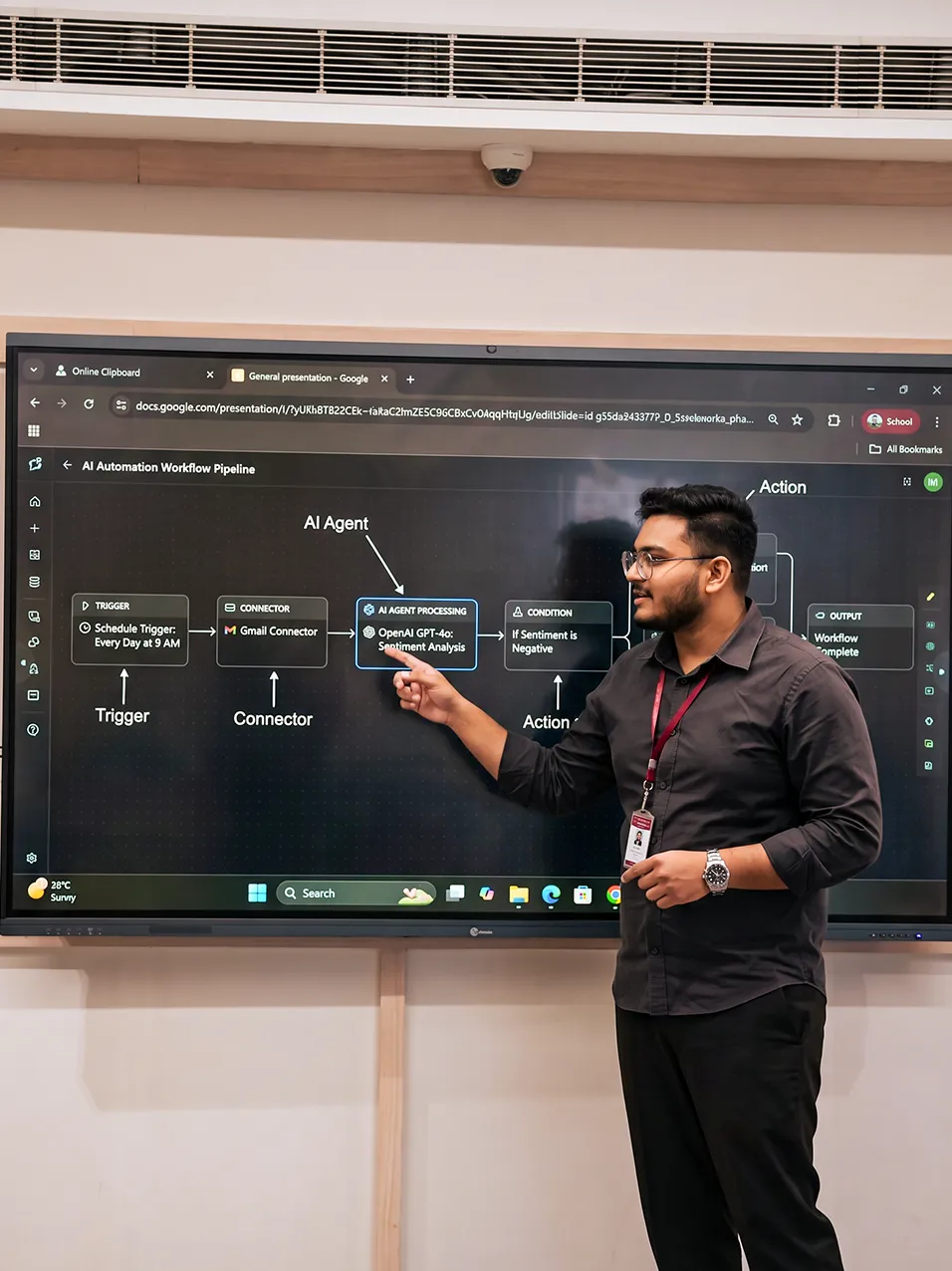
To develop intelligent systems that can learn and adapt. An AI and Machine Learning Lab is a dedicated space equipped with hardware and software to facilitate the development and testing of artificial intelligence (AI) and machine learning (ML) models. These labs typically include high-performance computing clusters, GPUs, cloud computing platforms, and development tools like TensorFlow, PyTorch, and Keras. They are used for a variety of purposes, such as natural language processing, computer vision, and reinforcement learning. Overall, AI and Machine Learning labs provide a valuable resource for individuals and organizations looking to develop intelligent systems that can learn and adapt.
Cloud Computing Lab
To explore the benefits of cloud-based services and infrastructure. An AI and Cloud Computing Lab is a dedicated space equipped with hardware and software to facilitate the development and deployment of AI applications in a cloud environment. These labs typically include cloud computing platforms (like AWS, Azure, or GCP), high-performance computing clusters, GPUs, and AI development tools. They are used for a variety of purposes, such as training and deploying large-scale AI models, leveraging cloud-based infrastructure for AI applications, and exploring the benefits of cloud-native AI solutions. Overall, AI and Cloud Computing labs provide a valuable resource for individuals and organizations looking to harness the power of AI and cloud technology.